Decorative
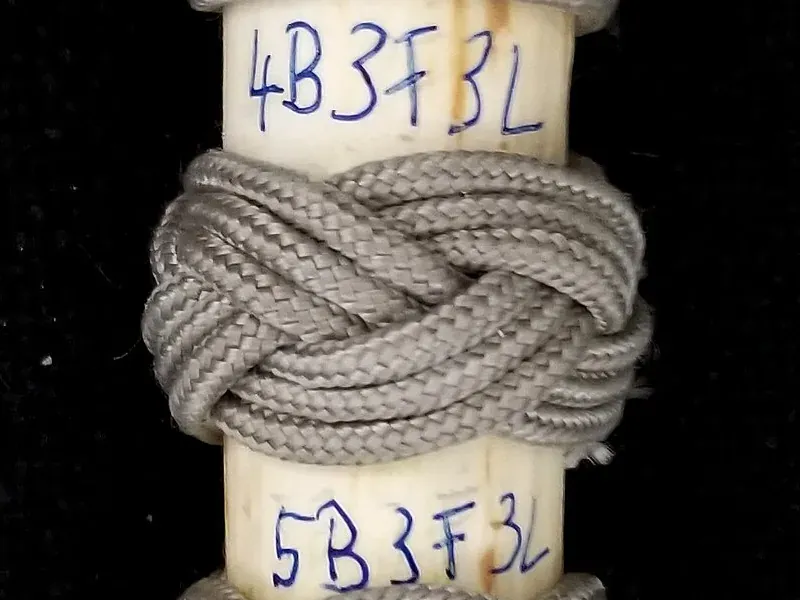
Turk's head knot
Turkish label on Wikipedia (not verified): Marsipet cevizi
A ring-shaped decorative knot woven around a cylinder; also used to mark a wheel or handle.
How to tie it
- The standing part comes from below; in the drawing the front of the bar is on the left, the back on the right. Take the end up BEHIND (under) the bar, over the top and down IN FRONT of (over) it: the first turn.
- Go round the bottom and start the second turn: up BEHIND (under) the bar.
- Come to the front and, going down, cross the first turn: OVER it, OVER the bar, OVER it again.
- Third turn: round the bottom and up BEHIND (under) the bar.
- Come to the front and start weaving: OVER, UNDER, OVER; then OVER the bar.
- Keep weaving: UNDER, OVER, UNDER; bring the end out beside where you started. The three-lead, four-bight Turk's head is closed.
- Even out the weave around the bar. If you like, follow the same path once or twice more to double or triple it; tuck the ends under the weave.
The method was checked against: Animated Knots: Turk's Head, Wikipedia: Turk's head knot.
No sourced Turkish name yet.
- Where not to use it
- As a load-bearing knot.
- Weakness
- Needs long and careful weaving.
Similar and alternative knots
Sources and verification
- Wikipedia: Turk's head knot
- Wikidata: Q2298614
- The tying steps were played in the rope engine to produce the checking signature; the comparison with two independent sources is in docs/pilot-baglar.md.